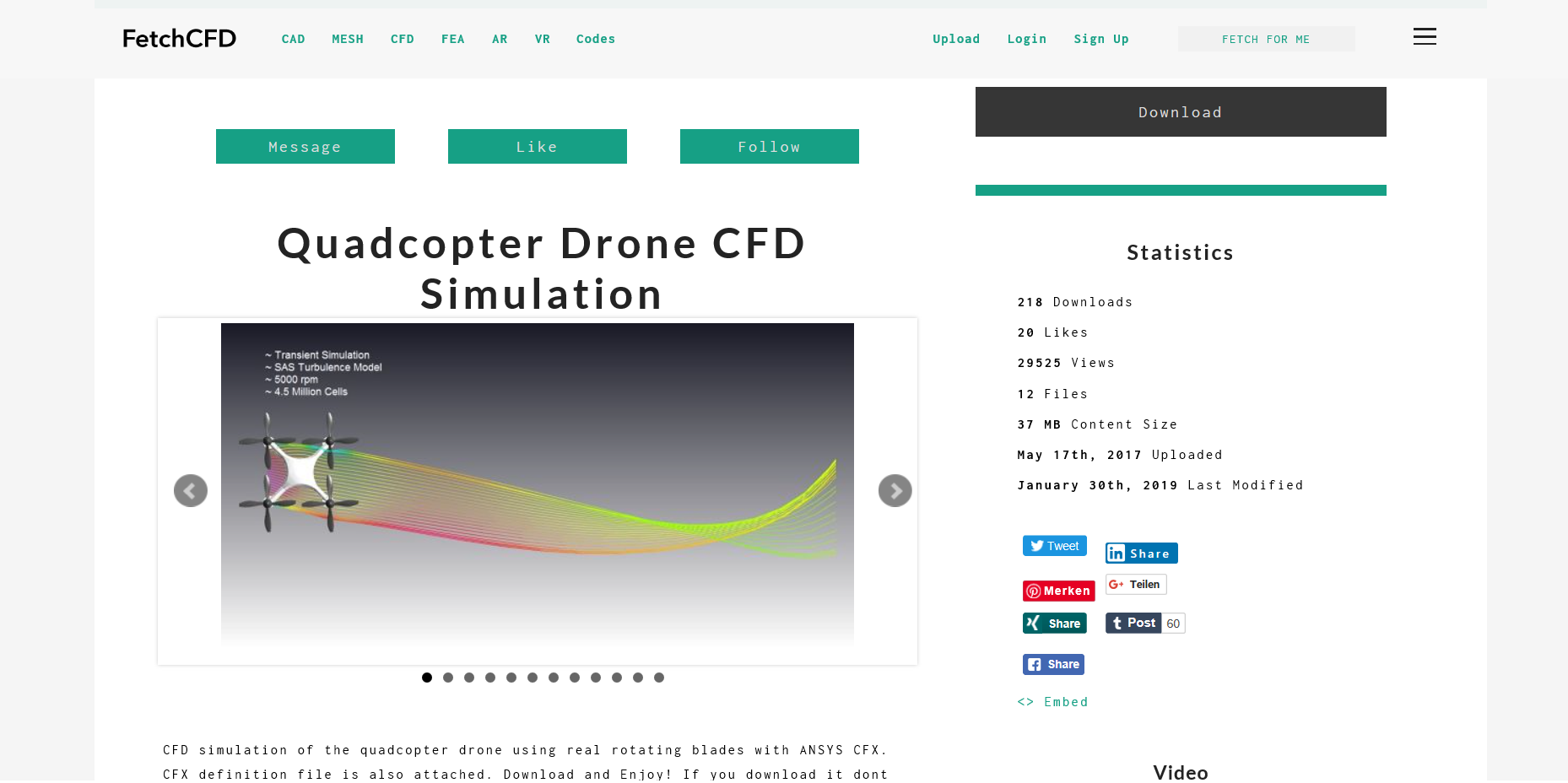
Here's a quiet frustration that anyone who's run a fluid simulation knows in their bones: you spend days computing how air moves around a wing, or wind funnels between two towers, and then you try to show someone. They don't have the software. They can't open the file. Your beautiful, GPU-melting result becomes a screenshot in an email.
FetchCFD's entire reason to exist is fixing that last mile. It's a web platform — think of it as a cross between a 3D Warehouse and a YouTube for simulations — where engineers and designers publish, share, explore and download CFD work in 3D, AR and VR, right in a browser. No install, nothing to maintain. It's grown into a community of over 37,500 engineers, designers, manufacturers, scientists and students, which tells you the "show someone" problem was bigger than it looked.
But it's not only a viewer, and that's where it gets interesting. So let's work through what it actually does, starting with the hard part.
First, what is CFD even computing?
Computational Fluid Dynamics is the art of predicting how a fluid — air, water, blood, exhaust — moves and pushes on the things in its path. The reason it's hard is that fluids are governed by equations with no clean answer; you can't solve them on paper for any shape that matters. So you chop the space into millions of tiny cells and let a computer grind out how the flow passes from cell to cell, step by step, until a picture emerges. That picture is the payoff: where the air speeds up, where it stalls, where pressure builds, where a design quietly bleeds energy.
FetchCFD aims this at exactly the problems CFD is famous for — complex flow interacting with rotating parts (think turbine blades, propellers) and porous media (filters, foams, packed beds) — and handles both steady-state (the settled, time-averaged answer) and transient (how the flow evolves moment to moment) simulations.
The part that surprised me: it'll solve, not just show
You'd expect a sharing platform to stop at viewing. FetchCFD also offers a solver based on the Lattice Boltzmann Method, and the choice is worth understanding because it's not the obvious one.
Traditional CFD solves the fluid equations directly across the grid — accurate, but the cells all talk to each other constantly, which is exactly the kind of math that bogs a computer down. LBM cheats elegantly: instead of tracking the fluid as a continuous field, it tracks little packets of "how much fluid is heading which way" hopping between neighbouring grid points and colliding. The macroscopic flow emerges from those simple local rules. And because each grid point mostly minds its own business, the whole thing maps beautifully onto a GPU, where thousands of cores can each chew on their own patch in parallel.
The result is high accuracy at a much faster pace than classical solvers, with turbulence handled by real models — Large Eddy Simulation (the Smagorinsky model) for resolving the big swirls directly, or k-omega SST for a faster statistical approximation. Translation: you get the genuinely useful turbulence physics without waiting a week for it.
Living in the browser
Because FetchCFD is web-based, "installation" is mostly a non-event — internet connection, a modern browser, done. The platform side gives you:
- An online 3D model viewer that opens a long list of formats right in the page: obj, 3ds, stl, ply, gltf, glb, off, step, iges, brep, FCStd, 3dm, bim, dae, wrl, 3mf, and ifc.
- An AR & VR viewer that drops simulations and models into augmented and virtual reality on most browsers, tablets and phones — handy for walking a client through airflow they can literally look around inside.
- An open simulation platform: publish results regardless of whether they came from open-source or commercial tools, sidestepping the file-compatibility wall.
- Private sharing for showing work securely to clients in 3D/AR/VR without making it public.
- Real-time collaboration across distributed teams, so nobody's emailing incompatible files at midnight.
- AI-enabled assistance, an interactive agent that explains simulation terms and methods — a gentle on-ramp when the jargon gets thick.
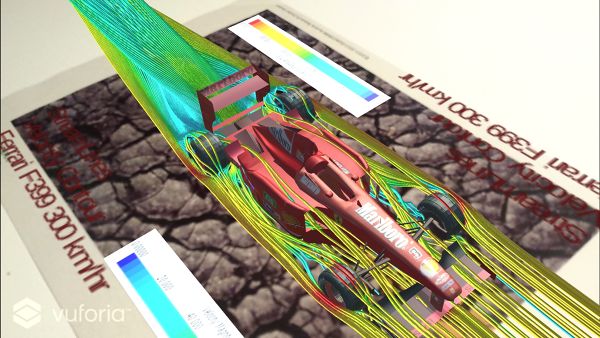 Ferrari Formula1 F399 Aerodynamics — Visualization in Augmented Reality
Running your own simulations
If you want to compute rather than just browse, FetchCFD plays nicely with the standard toolchain. It supports established codes — ANSYS Fluent, OpenFOAM, SU2 and others — across Windows, Linux and macOS. The flow is roughly: pick the solver that fits your problem, install it (or grab a setup from FetchCFD's simulation library), prepare or upload your case files, run, then publish the results back to the platform for viewing and sharing. Create a free account, and the Publish and Download buttons handle the round trip.
Who it's for
CFD shows up anywhere a fluid pushes on a design, which is more places than you'd think:
- Aerospace — aerodynamics of wings, fuselages and spacecraft, optimised for less drag and more performance.
- Automotive — airflow over cars and trucks, tuned for fuel efficiency and downforce.
- Energy — flow through turbines and heat exchangers in power systems.
- Manufacturing — fluid behaviour in casting, forging and extrusion, to improve molds and yields.
- Medical — blood flow through arteries and veins, to study disease and design treatments.
And for the architecture crowd this site is built for: the same machinery models wind loads around towers, natural ventilation through a floor plate, and thermal comfort in a courtyard — increasingly part of how serious buildings get justified.
What it costs
| Plan | Price | Storage / projects / simulations |
|---|---|---|
| Free | $0 | 10 GB · 10 projects · 10 simulations |
| Basic | $9.99/month | 50 GB · 50 · 50 |
| Pro | $29.99/month | 200 GB · 200 · 200 |
| Enterprise | Custom quote | Unlimited, plus bespoke services |
There's a 14-day free trial of Pro, plus discounts for students and educators (contact support to arrange one). Support runs through email and phone, advertised as 24/7, backed by documentation, tutorials and an FAQ.
The honest scorecard
Where it wins: it collapses the awful last mile of simulation work — sharing and viewing heavy CFD results becomes a link, not a software-install negotiation. The browser viewer's format list is genuinely broad, the AR/VR presentation lands well in client meetings, the GPU LBM solver is fast, and the tiered pricing starts at free.
Where it strains: it lives and dies by your internet connection — no offline mode, no local fallback. Power users may find the upper tiers pricey next to tools they already own. And the richer features lean on decent hardware, especially once you're solving rather than just viewing.
The bottom line
FetchCFD's best idea isn't a solver or a viewer in isolation — it's recognising that simulation has a distribution problem as much as a computation one, and tackling both in one browser tab. For a beginner, the AI assistant and gentle UI make a notoriously intimidating field approachable. For a team, the collaboration and AR/VR sharing turn a locked result into something everyone can actually explore.
Just keep one thing in view. A simulation that's this easy to publish and this pretty in AR is also this easy to trust — and a CFD result is only ever as good as the mesh, the boundary conditions and the assumptions you fed it. The platform will render your wind study gorgeously whether or not the physics underneath is sound. We can make every simulation look like a finished, authoritative answer now. Whether that makes us better at checking the ones that are quietly wrong is, uh... worth a thought before you forward the link. Beautiful airflow over a bad assumption is still a bad assumption — it just travels faster.
For the broader topic, the deep dive on simulation modeling covers the fundamentals this platform sits on top of.