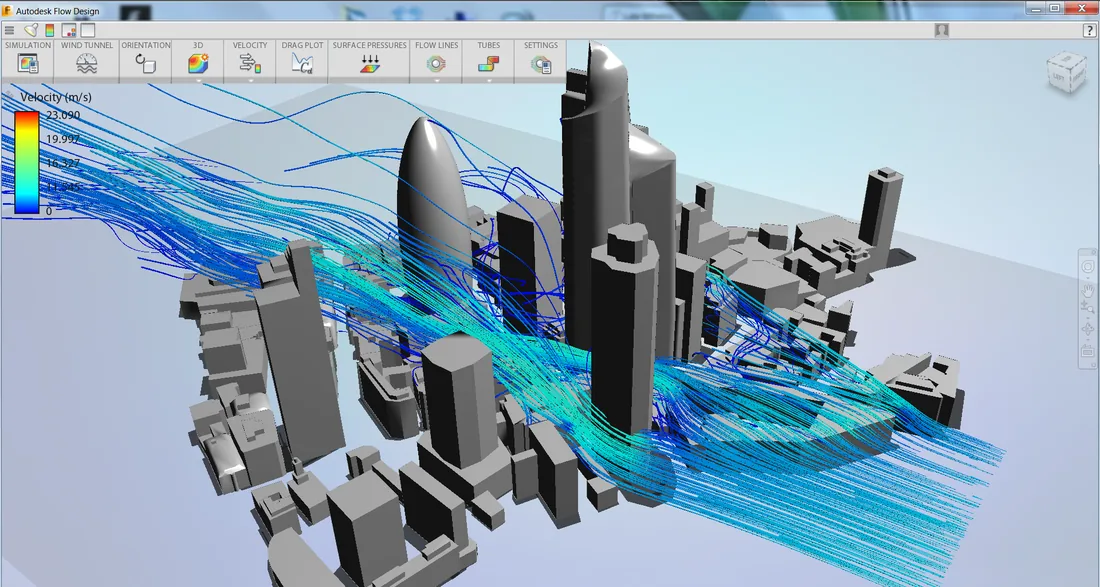
Suppose you want to know whether a new bridge design will hold, how long the queue at a redesigned airport will get, or what happens to a forest when a fire starts on a windy day. You have a problem: you can't just try it. Building the bridge to watch it fail is insane. Redesigning the airport to measure the queue costs millions. Setting the forest on fire is, let's say, frowned upon.
So you do the next best thing. You build a small, controllable copy of reality inside a computer, and you experiment on that. That's simulation modeling — and it's one of the most powerful ideas in engineering, because it lets you ask "what if?" about systems that are too expensive, too slow, too big, or too dangerous to poke in real life.
What it actually is
Simulation modeling uses mathematical models and computer programs to mimic how a real-world system or process behaves and interacts. Build the model well, and you can do four genuinely valuable things with it:
- Understand — see how a system works, what drives it, how it reacts to different conditions.
- Experiment — try scenarios and alternatives, and weigh the trade-offs, without real-world consequences.
- Optimize — hunt for the best strategy, configuration or policy.
- Predict — forecast future behaviour and prepare for the risks and opportunities it reveals.
If that sounds like a cousin of procedural modeling, it is — both use algorithms to generate content automatically. But their goals differ: procedural modeling cares about producing realistic 3D form; simulation modeling cares about reproducing real behaviour. Procedural asks "what does it look like?"; simulation asks "what does it do?" Combine them — simulate the dynamics, procedurally generate the geometry — and you get living, lifelike worlds: cities that flow, landscapes that weather, crowds that move.
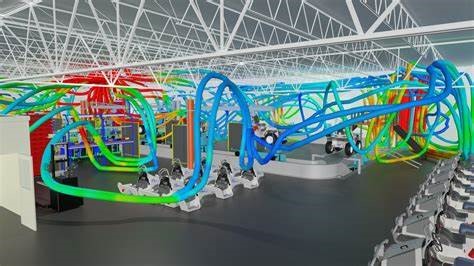 Simulation modeling feeding procedural 3D content creation
The seven steps, and the two that trip everyone up
A simulation study follows a fairly standard arc:
- Conceptualization — define the objective, scope and boundaries; name the key variables and assumptions.
- Data collection — gather the real-world data the model needs to be built and checked against.
- Model development — express the system's structure and logic as equations, rules or code.
- Verification — confirm the model is implemented correctly: no bugs, no errors, no inconsistencies.
- Validation — confirm the model is accurate: its outputs match real-world observations.
- Experimentation — run it under varied scenarios and record what happens.
- Analysis — interpret the results, and be honest about their significance and limits.
Steps 4 and 5 are where good intentions go to die, and the distinction between them is the single most important idea in the whole field. Verification asks: did I build the model right? (Does the code do what I intended?) Validation asks: did I build the right model? (Does what I intended actually match reality?) You can have a flawlessly coded, bug-free simulation — perfectly verified — that confidently predicts nonsense because its assumptions never matched the world. Verification is engineering; validation is humility. Skip the second and you've built a beautiful machine for being precisely wrong.
The flavours of simulation
Different systems need different kinds of model:
| Type | What it models | Example |
|---|---|---|
| Discrete Event | A system as a sequence of distinct events that change its state | A bank or supermarket checkout queue |
| Dynamic | Continuous change over time, via differential/difference equations | A predator–prey system (wolves and rabbits) |
| Process | A physical or chemical operation | A distillation column, reactor or heat exchanger |
| Data | Synthetic datasets from a statistical or ML model | Customer behaviour, market trends, network traffic |
Picking the wrong type is like choosing the wrong tool for a screw — you might force it, but you'll strip the head. A queue is events; a population is dynamics; a refinery is process. Match the model to the system's actual nature.
The tools, and what each is for
Three platforms cover most of the territory, and they're genuinely different beasts:
MATLAB — a high-level language and environment for numerical computation. Best for mathematical and engineering problems: signal processing, control systems, optimization, with toolboxes like Simulink, Simscape and SimEvents. Strengths: easy syntax, vast libraries, fast and accurate on heavy math. Weaknesses: expensive and proprietary, and it's not a natural fit for discrete, stochastic or agent-based behaviour. Think: a pendulum via an ODE solver, or a solar-power system in Simscape.
AnyLogic — a graphical, Java-backed platform that's the Swiss-army knife here. Best when you need multiple methods — discrete-event, continuous and agent-based, often in one hybrid model — across logistics, manufacturing, healthcare or urban planning. Strengths: intuitive drag-and-drop, comprehensive libraries, rich 2D/3D animation and built-in experiments (optimization, sensitivity, Monte Carlo). Weaknesses: a steep learning curve and a business/industrial bias that suits it poorly to deep physical-chemical phenomena. Think: a supply-chain network or a pedestrian crowd.
NetLogo — a friendly, Logo-based platform built for agent-based and complex-adaptive systems: social, ecological, cellular. Strengths: simple, playful, brilliantly educational, and surprisingly powerful at emergent behaviour from simple rules. Weaknesses: narrow (not for discrete-event or continuous work) and low on fine-grained control. Think: flocking birds, a spreading forest fire, or Conway's Game of Life.
The rule of thumb: math and engineering → MATLAB; mixed-method business systems → AnyLogic; emergent agent behaviour → NetLogo.
The bottom line
Simulation modeling is, at its heart, the art of building a trustworthy little universe and then asking it hard questions. Master it and you can stress-test a bridge, optimize a factory, or predict a market without touching the real thing — answering questions reality would charge a fortune to answer.
But "trustworthy" is the load-bearing word, and it's worth one last note of caution. A simulation produces confident, precise, beautifully-charted numbers whether or not its assumptions are sound — and confidence is seductive. We can model almost any system now, in stunning detail. Whether the model is telling us about the world or just about our own assumptions dressed up as the world is, uh... exactly what validation is for, and exactly the step people are most tempted to skip. Build the model right, then make sure it's the right model — and the tiny universe you've built becomes something you can actually believe.