
Let's not bury the lede behind a thousand words of reassurance. Here's the honest answer to "will AI replace architects?": it depends on which half of the job you think the job is.
If being an architect means pushing lines around in CAD until 2am, photoshopping renders, and waiting for the machine to spit out a 3D view — then yes, something is coming for that half, and it's coming fast. If being an architect means thinking — reading a site, wrestling a constraint, inventing a spatial experience that didn't exist before — then no, and arguably AI just handed you more time to do it. The profession is facing its biggest shift since CAD arrived, and the people at firms like BIG (Bjarke Ingels Group) who are actually using these tools tend to land in the same place: this is disruption, not deletion.
So let's work the problem properly, because the stakes here are people's careers.
The three eras of the architect
A useful frame for where we are: the profession has lived through three versions of itself.
- Architect 1.0 — the manual era. Hundreds of people on huge floor plates, drawing buildings by hand.
- Architect 2.0 — the computer-aided era. The current default: computers as fast, tireless executors of tasks we still fully direct.
- Architect 3.0 — the AI-collaborative era. Small, nimble teams working with AI to take on projects that used to need an army.
Each transition didn't eliminate architects. It changed what an architect spends their day doing. CAD didn't end the profession; it ended the drafting board. AI is the next move of that same kind — and notice the direction of travel. We're going from "computerized slaves executing tasks faster" to a collaborator that can propose, not just produce.
What AI is genuinely good at — and what it isn't
Be specific, because vague fear is useless. Here's what AI reliably handles today:
- Endless nights pushing renderings around in Photoshop
- Line-by-line CAD drafting
- Waiting hours for basic 3D renders
- Repetitive modeling
- Time-sink administrative work
And here's what it conspicuously can't do, and the reason matters:
- It has no contextual understanding. An AI image is, bluntly, thoughtless — it's pretty, but there's no site research, no reasoning, no why behind a single decision in it.
- It can't be precisely controlled to meet the specific, non-negotiable requirements a real building imposes.
- It can't problem-solve. It doesn't analyze a site, doesn't know your building codes, doesn't resolve the unique puzzle that every project actually is.
That gap isn't a temporary bug to be patched in the next release. It's the difference between generating an image of a building and designing a building. The value of the architect, as the people doing this for real keep insisting, is still the thinking — the site analysis, the context, the spatial experience, the stakeholder diplomacy. AI generates outputs. Architects make decisions. Those are different jobs that happen to produce similar-looking pictures.
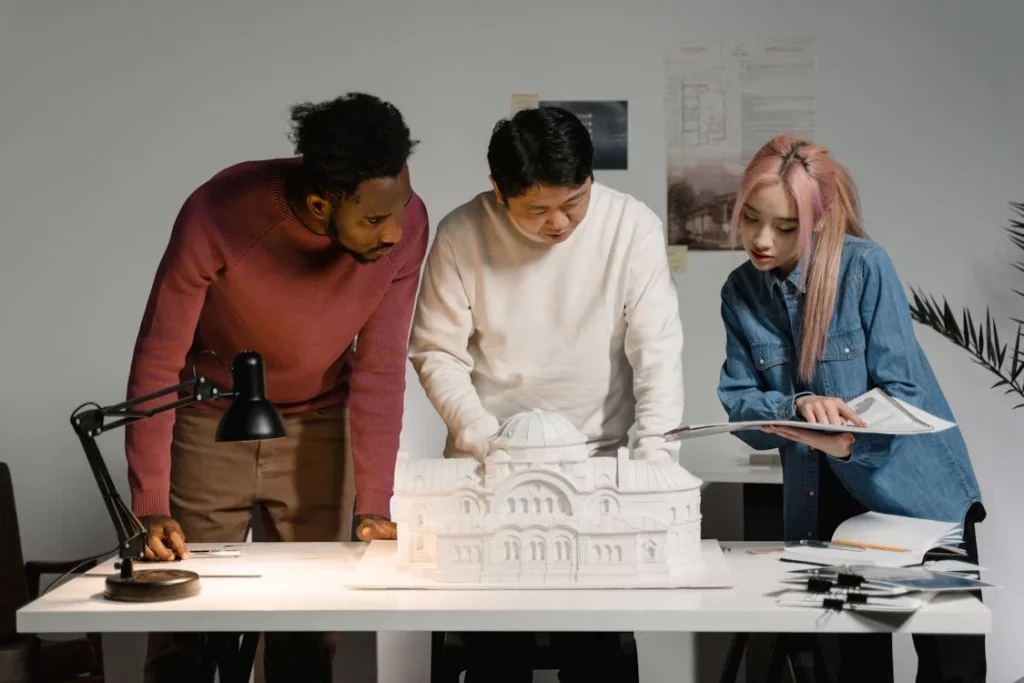 Smaller teams, more collaboration, more diverse practices
How practice actually changes
The realistic near future isn't empty offices — it's smaller ones. Teams of 5–15 taking on work that used to need 50-plus. A more diverse spread of specialized practices. And — genuinely good news if you don't run a giant firm — small studios able to compete on complex projects that were once out of reach.
AI slots in as a collaborator, the same way the profession has absorbed new partners before: Grasshopper scripting away the repetitive geometry, real-time engines like Enscape handing back control over visualization, BIM streamlining the documentation grind. Right now, at working firms, AI mostly does three things: idea iteration (Midjourney as a kind of "super Pinterest" for fast concept exploration), automation (ChatGPT for admin and research), and visualization (AI woven into rendering for faster iterations). Wiring design tools directly into AI platforms is still largely experimental — but that's where it's heading.
The pressure won't land evenly, and pretending otherwise helps no one. Visualization-only firms face the most immediate squeeze. Entry-level roles will assume AI fluency. Design cycles will accelerate hard, and team sizes may shrink even as output climbs. Meanwhile, whole new roles appear: AI implementation specialists, design-technology managers, prompt-engineering experts, human-AI collaboration consultants.
Reading the market: attitudes that age well, and badly
You can predict who'll thrive partly from how they talk about this:
| Doesn't age well | Ages well |
|---|---|
| "AI is a fad that'll pass" | "AI is here to stay; I need to adapt" |
| "I'll wait until it's perfect" | "I'll learn as it evolves" |
| "AI makes my skills worthless" | "AI makes my thinking skills more valuable" |
| "Only tech people can use AI" | "I can learn to collaborate with these tools" |
The throughline: don't ignore it, don't fear it. The thinking architect keeps a place in shaping the built world. The one who defined themselves entirely by tool-mastery has a harder decade.
What to actually do about it
Skip the panic; do the work. Roughly in order:
- Build AI literacy now. Make a Midjourney and a ChatGPT account today and actually prompt them. Add Stable Diffusion with ControlNet for real control, and explore render-side AI in tools like D5. The point isn't mastery; it's fluency — knowing what these things can and can't do.
- Strengthen design thinking. The conceptual, problem-solving core is precisely the part AI can't touch, which makes it the part worth doubling down on.
- Practice collaboration. Treat AI as a design partner you direct, not a vending machine — and document what works and what doesn't.
- Stay adaptable. The specific tools will churn. Learning how to learn them is the durable skill.
What gets less critical, honestly: advanced CAD wizardry, manual rendering chops, repetitive modeling, time-intensive visualization technique. Useful to understand; no longer your moat.
For students, the advice inverts neatly: learn the traditional fundamentals and add AI literacy on top. Design fundamentals are how you'll know whether the AI's output is any good; AI fluency is how you'll keep up. Critical thinking is the thing that appreciates in value while everything mechanical depreciates.
The part worth sitting with
Here's where I'll let the sceptic in the corner speak, because this whole topic deserves it. The pitch is that AI frees architects to return to "the creative core" — and that's genuinely possible. But notice the quiet assumption underneath: that when the drudgery disappears, we'll spend the reclaimed hours thinking harder, rather than just producing more, faster. We can now explore a hundred concepts before lunch. We can. Whether a profession under deadline and budget pressure will use that speed to think more deeply, or simply to ship more options that nobody had time to interrogate, is — uh... not a software question. It's a question about us. And it's the one the demo reel is very careful not to ask.
The bottom line
Industry disruption: yes, absolutely, make no mistake about it. Job elimination: no — not for the architect whose value was the thinking all along.
So if you're a working architect: don't panic, start experimenting, and pour your energy into design reasoning and problem-solving. If you're a student: get the fundamentals and the AI literacy, and treat adaptability as a core skill rather than a chore. The future belongs to architects who can think critically, solve hard problems, and collaborate with AI to make better buildings faster — which, stripped of the hype, is just architecture returning to its creative center. If we're willing to evolve with it.
For the practical next step, the Midjourney tips for architects guide is the place to start putting hands on keys.