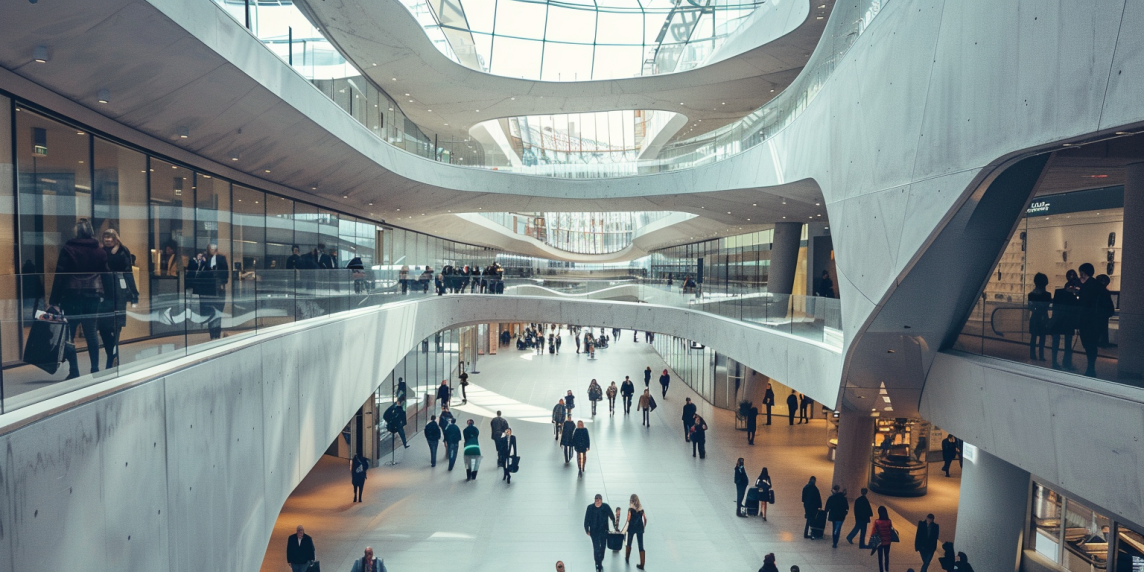
For most of architecture's history, the bottleneck was the human hand. A design existed at exactly the speed someone could draw it — sketches on paper, balsa-wood models, a draftsman inking a section by lamplight. It produced iconic buildings, but it was slow, hard to revise, and unforgiving of second thoughts.
Then, in waves, the bottleneck moved. CAD digitized the drawing board. BIM turned drawings into intelligent models. And now AI is moving the bottleneck again — and this time the hype is loud enough that it's genuinely hard to tell what's real. So let's trace the evolution honestly, capability by capability, and be clear-eyed about where the marketing outruns the machine.
Where the real leverage is: generative design and prediction
The most substantive shift AI brings to design itself is generative design. Feed an algorithm your constraints — the site's spatial limits, your aesthetic targets, environmental factors like sun and wind — and it produces a multitude of valid design options, fast. The architect's job shifts from drawing one option to curating among many, which widens the search for a good answer enormously.
The second real leverage point is prediction before construction. AI-driven simulation can estimate how a building will perform — energy use, structural behaviour, daylight, occupant comfort — long before a single brick is laid. Catching a thermal problem in a model is free; catching it on site costs a fortune. That predictive loop, tightening the design against reality early, is where a lot of the genuine value lives.
Beyond design: planning and the building site
AI's reach extends past the drawing into how buildings actually get made:
- Project planning: models trained on historical project data forecast timelines, budgets and risks more accurately than gut feel, chipping away at the delays and overruns that have plagued construction for decades.
- On site: robots and drones are starting to take on bricklaying, surveying and quality inspection — accelerating the build and, importantly, taking humans out of hazardous tasks.
- Logistics: AI optimizes where materials and resources need to be and when, cutting waste.
And in operation, AI tied into a building's sensors can tune energy, water and waste in real time — the substance behind the "smart building" label, producing structures that are cheaper to run and more responsive to the people inside.
Midjourney V6: what it genuinely does (and what it doesn't)
Now the honesty section, because this is where a lot of writing goes off the rails. Midjourney V6 is a real and important tool — but it is a text-to-image generator, and it's worth being precise about that, because the internet will happily tell you otherwise.
What V6 genuinely changed: it got dramatically better at understanding natural-language prompts (no more cryptic keyword incantations) and at producing photorealistic, atmospheric images. You describe a building in plain English and get back a strikingly convincing visualization. For an architect, that's real value at a specific moment — early concept exploration and client-facing imagery. Here's an actual prompt and the kind of result it yields:
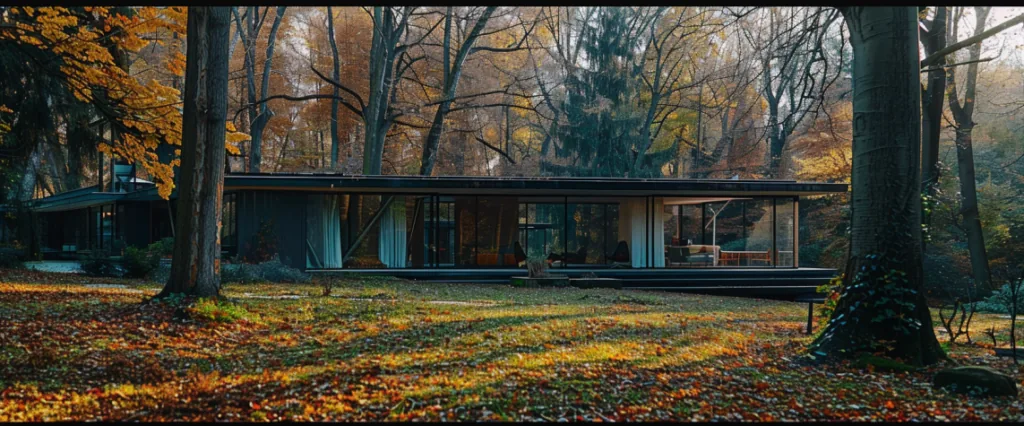
a view of a Mies van der Rohe house in a calm forest, with nature, warm color palette --ar 7:3 --style raw
Now, what Midjourney does not do, despite breathless claims to the contrary: it has no "parametric design module," it does not generate dimensioned floor plans, it does not run material simulations, and it does not integrate with AutoCAD, Revit or SketchUp. It generates pictures. Pixels, not buildings. Treating its gorgeous output as if it were a construction document is exactly the mistake this site exists to talk you out of. The genuine workflow is: dream in Midjourney, build in your real modeling and BIM tools.
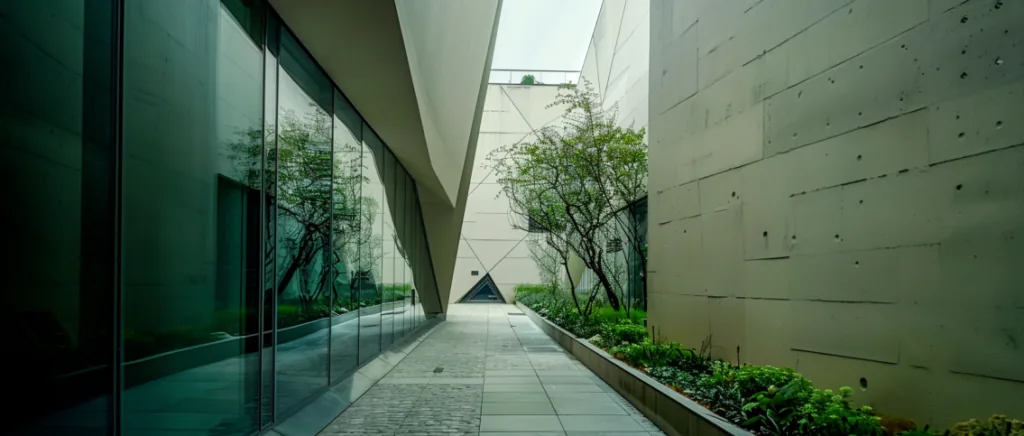
a view of a modern Daniel Libeskind museum building in an urban courtyard, moody, fragmented architecture, light color palette --ar 7:3 --style raw
Used for what it actually is — a fast, fluent concept-visualization tool — it earns its place. The rapid prototyping is the real benefit: a conceptual idea becomes a shareable image in minutes, so you can explore ten directions before lunch and bring clients into the conversation with something they can actually react to.
The real challenges of bringing AI in
Adopting AI in a practice isn't frictionless, and the honest obstacles are worth naming — along with the genuine (not magic) ways firms address them:
| Challenge | The honest reality |
|---|---|
| Data integration | Architectural data is messy and lives in many formats; getting it into a usable shape is real work, not a checkbox. |
| Learning curve | These tools demand new skills. The fix is training, time, and pairing AI-literate people with design-literate ones. |
| Creative control | The fear that AI will flatten a designer's voice is legitimate; the answer is treating AI as a draft generator you override, never an authority. |
| Cost | Subscriptions and hardware add up, especially for small firms. Cloud and tiered plans let you start small and scale. |
| Ethics and bias | Models inherit the biases in their training data. Diverse, representative data and human review are the only real guardrails. |
Notice none of these are solved by a feature. They're solved by process — by humans deciding how to use the tools well.
Where this is heading
Project the trend lines and a few things look likely. Efficiency keeps climbing as generative tools get better at turning intent into options. AI spreads across disciplines — not just design but construction management, materials and building systems, stitched into a more holistic process. Data-driven design deepens as smart-city and sensor data feed back into how buildings are shaped. Personalization rises, with spaces tuned to individual clients. Sustainability stays central, with AI pushing past energy-efficient toward genuinely regenerative buildings. And VR/AR fuses with AI so clients can walk through a design before it's built.
The bottom line
The arc is clear and genuinely exciting: from the limits of the human hand, to CAD's precision, to BIM's intelligence, to AI's speed and breadth. Each step didn't replace the architect — it moved the bottleneck and freed up judgment.
But here's the note to end on, because this whole topic runs hot. The promise is that AI returns architects to pure creativity by handling everything else. Maybe. The risk is subtler: a tool like Midjourney makes unbuilt, unconsidered ideas look utterly finished and authoritative, and a photoreal image is extraordinarily persuasive — to clients, and to ourselves. We can now generate a stunning building in thirty seconds. We can. Whether a profession that can manufacture conviction that fast will stay honest about the difference between a beautiful picture and a good building is, uh... not a question the software can answer. It's one we have to. Use the tools for what they truly do, keep the human judgment in the loop, and the evolution is a gift rather than a trap.
For the bigger argument about AI's role, see the rise of AI tools in architecture; for hands-on prompt craft, the Midjourney tips for architects guide.